Guide
How to Actually Know If a Diet Change Worked
"I feel like it's helping" is not proof. Here is what a real before/after test looks like.
· mymir team
"I feel like it's helping" is not proof — it is a guess dressed up as an observation. Most people never actually test a diet or habit change; they just start doing it, keep doing it if nothing goes obviously wrong, and eventually forget whether it made a measurable difference at all. Here is what an actual test looks like.
1. Change one thing at a time
If you cut late-night snacking, added more fibre, and started walking after dinner all in the same week, and something improves, you have no way to know which change caused it. Isolate the variable. It is slower, but it is the only way the result means anything.
2. Set a baseline before you start
You need a "before" to compare the "after" against. That means a few days of your normal pattern, measured the same way you plan to measure the test period — same metric, same time of day, same conditions.
3. Run the test for long enough to beat the noise
A single day tells you almost nothing. Cleveland Clinic notes normal day-to-day weight variation runs about 2–3 pounds in either direction from water retention, sodium, and sleep alone — before diet or exercise even enter the picture. Five days is usually enough to separate a real effect from that noise without dragging the test out so long you lose track of what you changed.
4. Pick a measurable outcome before you start, not after
Decide in advance what "worked" means — average energy across the week, a weight trend rather than a single weigh-in, hunger levels, workout performance. Choosing the metric after the fact makes it too easy to pick whichever one happened to move in the direction you wanted.
5. Compare averages, not single days
Compare the average of the baseline period to the average of the test period. A single great day during the test, or a single bad day during the baseline, should not be allowed to decide the outcome on its own.
A simple framework
- Pick one change to test — not several at once.
- Log a baseline for a few days without changing anything.
- Make the change and hold everything else steady for about five days.
- Compare the test period's average to the baseline's average, on the metric you picked up front.
- Decide: keep it, drop it, or adjust and test again.
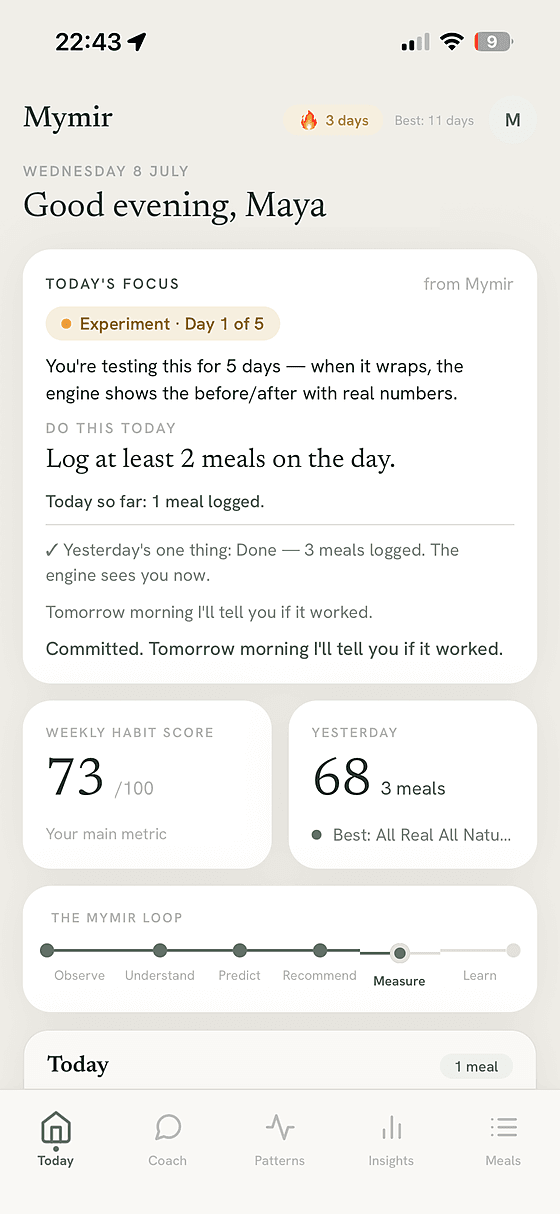
This is close to how mymir runs it natively — every change becomes a five-day experiment with a defined baseline and a measured result at the end, so you get a straight answer instead of a feeling. The framework works with or without an app; mymir just automates the bookkeeping so you actually run it consistently.
Frequently asked
Related reading
See it for yourself
mymir is live on the App Store. Free to download, free to start — see what it notices in your first week.
Download on the App Store →