Guide
Why Calorie Tracking Stops Working After a Few Weeks
It is not a willpower problem. Most tracking apps are built to collect data, not to prove anything with it.
· mymir team
Most people who try calorie tracking stop within weeks. That is not a willpower problem — it is a design problem. Most tracking apps are built to collect data, not to prove anything with it, and logging without a payoff is exhausting to sustain.
1. Logging has no feedback loop
You log breakfast, lunch, and dinner, and the app gives you a total. It does not tell you whether yesterday's total was better or worse than what you are trying to achieve, or whether a change you made three days ago is actually working. A systematic review published in the International Journal of Behavioral Nutrition and Physical Activity found that the quality and specificity of feedback materially affects whether people keep up self-monitoring at all — generic or absent feedback is a known driver of disengagement, not just an inconvenience.
2. One bad day looks like the whole story
Weight and hunger fluctuate for reasons that have nothing to do with whether your plan is working. Cleveland Clinic's guidance puts normal day-to-day weight variation at roughly 2–3 pounds in either direction — driven by water retention, sodium, sleep, and hormonal shifts, not fat gained or lost overnight. As one of their clinicians puts it, "the scale is a horrible barometer of behavior change." Judging a change by how one day looks is close to judging it by noise. Most apps present daily numbers front and centre and leave the noise-filtering to you.
3. Every recommendation is generic
"Eat more protein." "Move more." Generic advice is not wrong, exactly, but it is not personal either, and advice that ignores what is actually happening in your data stops feeling worth acting on.
4. Nothing happens when you go quiet
A missed day of logging is itself a signal — travel, a busy week, burnout, loss of motivation — but most apps just sit there with an empty entry. No check-in, no acknowledgement, which makes it easy to quietly stop for good rather than pick back up.
What actually fixes this
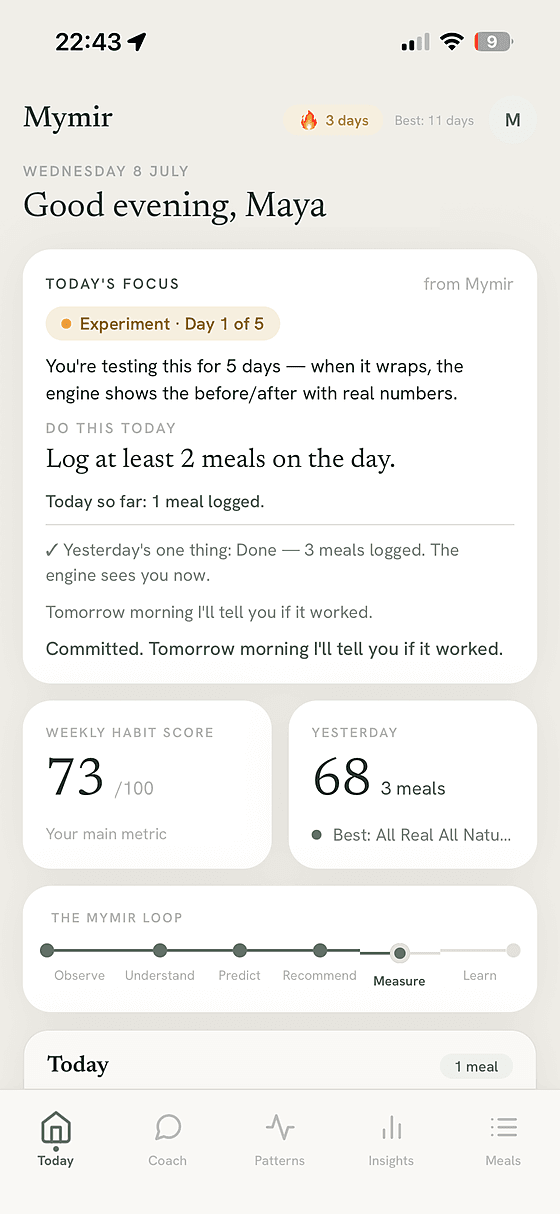
The fix is not logging harder. It is turning logging into evidence:
- Test one change at a time, for long enough (about five days) to see past daily noise.
- Compare a period to a baseline, not day-to-day, so a single bad night does not read as failure.
- Get a straight answer on whether the change worked, instead of having to interpret a graph yourself.
- Get checked on, not judged, when logging lapses — a gap is information, not a failure.
This is the structure mymir builds around every change: Observe → Understand → Predict → Recommend → Measure → Learn, run as a five-day experiment with a measured result at the end, plus a coach that checks in without shame mechanics when you go quiet. It is the same fix, built into the app instead of left to you.
Frequently asked
Related reading
See it for yourself
mymir is live on the App Store. Free to download, free to start — see what it notices in your first week.
Download on the App Store →