Comparison
mymir vs MyFitnessPal: When Logging Isn't Enough
MyFitnessPal will tell you what you ate. It won't tell you if changing it worked.
· mymir team
MyFitnessPal has been the default calorie tracker for over a decade, and it earned that spot honestly: a food database spanning roughly 20 million items and 68,500 brands, fast barcode scanning, and a logging habit that millions of people have built their routine around. If your only goal is a running tally of calories and macros, it does that job well.
The problem shows up a few weeks in. You have logged every meal, hit your calorie target most days, and the app has produced a tidy graph — but you still cannot answer the actual question you started with: is this working? MyFitnessPal was built to record what you ate, not to test whether a specific change you made is having an effect. That gap is where most people quietly stop logging.
Even MyFitnessPal is admitting logging alone isn't the whole answer
In December 2025, MyFitnessPal quietly acquired Cal AI — the viral AI photo-logging app — and folded it into its lineup, formally announcing the deal in March 2026. Cal AI now runs on MyFitnessPal's food database while staying a separate app. That's a tell: the incumbent decided photo-based AI logging was worth buying rather than building from scratch. It says the input method needed fixing. It doesn't say anything about the bigger gap — telling you whether a change actually worked — which neither MyFitnessPal nor Cal AI does.
What each app is actually optimised for
MyFitnessPal optimises for logging completeness — get every gram of food into the database, as fast as possible. mymir optimises for a different question: out of everything you are doing, what is the one thing worth changing next, and did it work? That difference shows up in what each app asks you to do every day.
| MyFitnessPal | mymir | |
|---|---|---|
| Pricing (2026) | Free (ads, limited); Premium $19.99/mo or $79.99/yr; Premium+ $24.99/mo or $99.99/yr | Free tier + Pro; Pro pricing goes live at launch |
| Logging method | Manual search, barcode scan (voice/photo scan on Premium) | Photo, plain text, or barcode — on the free tier |
| What you get back | A calorie and macro total | A daily health score, one concrete action, and patterns in your data |
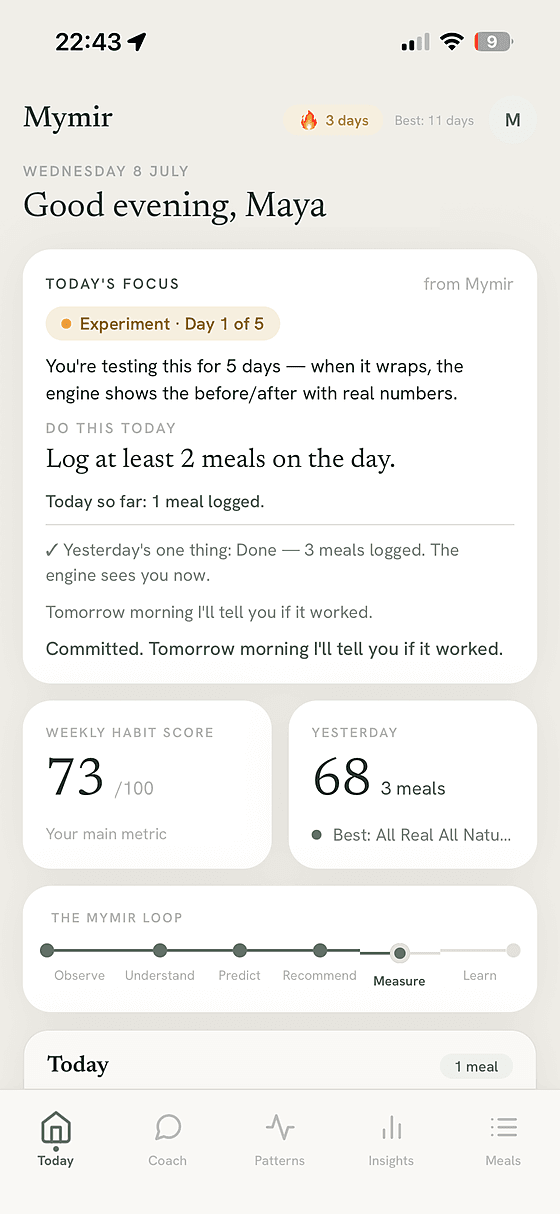
| Proof a change worked | You have to work it out yourself from graphs | Structured 5-day experiments with a measured before/after |
| When you go quiet | Nothing — the app waits | Your coach checks in, no streak-shaming |
| Recommendations | Generic recipe database | Filtered to your diet, allergies, and macros left today |
Where MyFitnessPal still wins
If you want the largest possible packaged-food database, or you are already deep into a logging habit and just need a reliable ledger, MyFitnessPal's scale is real and mymir does not try to out-database it. The difference is what happens after the food is logged.
Where mymir is built differently
Every change in mymir — cutting late-night snacks, adding a fibre target, shifting when you eat dinner — becomes a structured five-day experiment: Observe → Understand → Predict → Recommend → Measure → Learn. At the end, mymir tells you with real numbers whether it worked, instead of leaving you to eyeball a graph and guess. It also reads sleep and activity from Apple Health, so a pattern like "low energy" gets checked against more than just food.
The logging itself is also lighter: a photo or a plain-text message like "raita, coke, salad" is enough — no searching a database entry by entry for every ingredient.
Frequently asked
Related reading
See it for yourself
mymir is live on the App Store. Free to download, free to start — see what it notices in your first week.
Download on the App Store →